
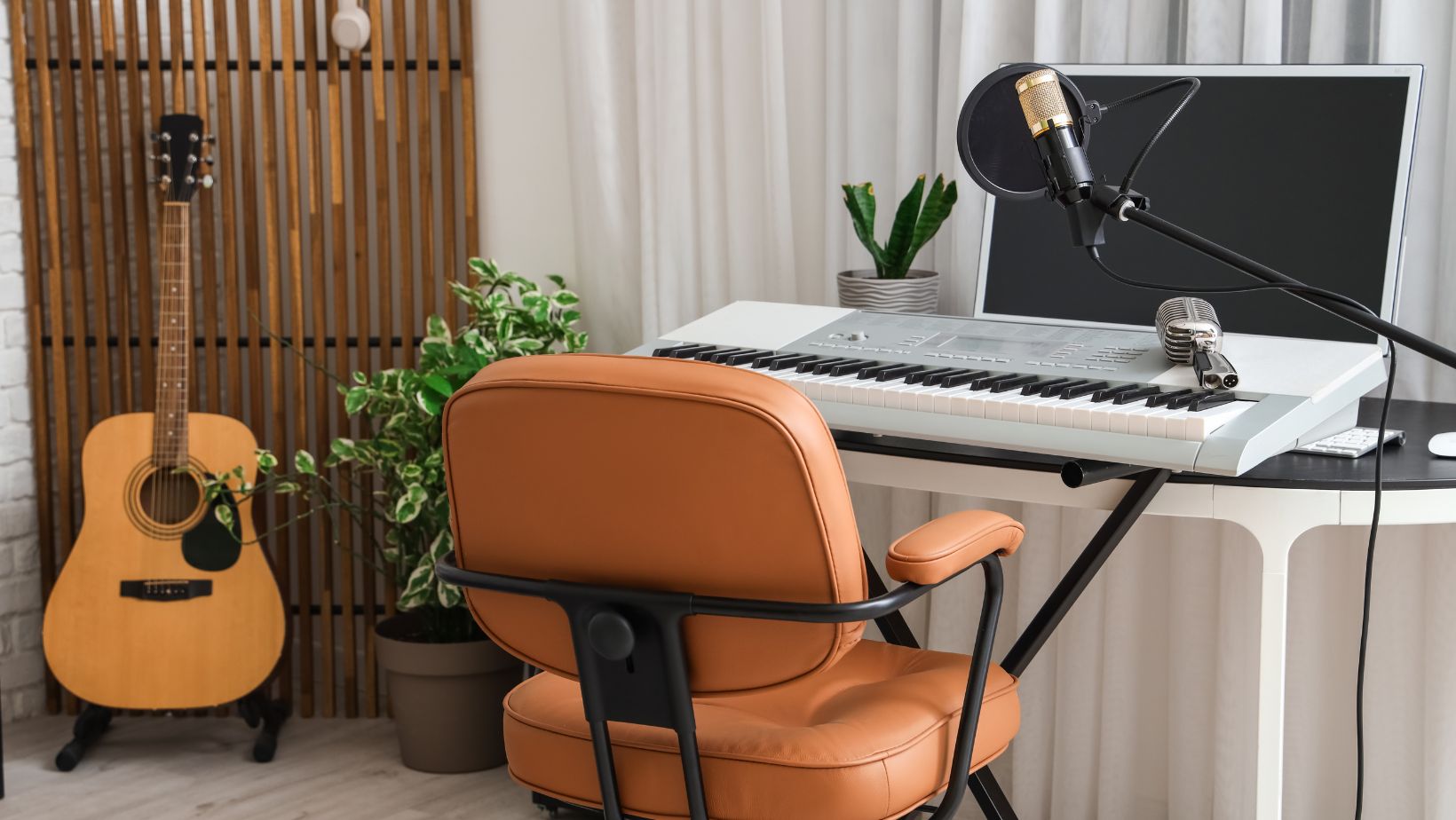
A modern recording studio, in spirit, resembles a workshop where everything should be at hand to capture your idea as quickly as possible. We have a universal, ready-made solution that will give you free rein in your musical creativity.
Let’s immediately highlight the two main tasks that our setup addresses:
- High-quality monitoring
- Production related to vocal recording
Ready-Made Setup for Monitoring
Our setup includes ADAM Audio T5V monitors, IsoAcoustics stands, and an Audient iD14 MKII audio interface. Let’s look at each component in more detail.
ADAM Audio T5V Monitors
For quality mastering, you need monitors that can provide the most honest, uncolored sound picture. As an accessible and accurate tool, we suggest monitors from the renowned manufacturer ADAM Audio. The German brand is well-known, and interestingly, has always focused solely on monitor production. Previously, the company didn’t have budget-friendly models, and many sound enthusiasts couldn’t afford their expensive monitoring line. However, everything changed with the release of the T series.
Today, we’re looking at the entry-level ADAM Audio T5V monitors. The model is equipped with robust components that deliver linear and detailed sound. The high frequencies are handled by the new U-ART tweeter — a revolutionary solution in this segment. Previously, you had to pay a much larger sum for a ribbon tweeter, but now — voilà! The high-frequency driver plays up to 25 kHz.
Based on our listening experience, we can assure you they definitely don’t “hit the ceiling” nor fatigue the ears, as can sometimes happen with ribbon tweeters. Another feature of the high-frequency driver is its precision waveguide, borrowed from the flagship S series.
However, at home you can also visit this brand – Voltage Bet, getting excitement and lots of sports in one place.
The essence of such waveguides is that you no longer need to sit rigidly in an equilateral triangle to perceive the necessary sonic information. The sound now spreads much wider — this positively affects perception and spaciousness without losing detail.
In the mid-bass range, a 5-inch driver operates with a “bottom point” around 45 Hz. ADAM Audio sound is particularly valued when working with electronic music, as their monitors possess deep, well-developed bass that is easily perceptible even with the slightest EQ change.
Like most active monitors in this segment, the T5Vs have a bass-reflex design. However, note that the bass-reflex ports are located on the rear panel, meaning there are placement nuances — you definitely cannot put them right against a wall.
IsoAcoustics Stands
What should you place the T5Vs on? You didn’t think we’d just put them on a table, did you? The issue is that your desk will resonate, adding coloration and creating a “fat” sound. You might think your mix is perfectly balanced, but that illusion will disappear when you listen to it elsewhere.
To avoid such disappointment, you need to mount the speakers on decoupling stands that combat vibration.
The key feature of the IsoAcoustics ISO-130 stands is the combination of rigidity and setup flexibility: you can adjust the tilt and height so the speakers aim directly at the listener and the tweeters are at ear level — ideal for comfortable work. The stand’s frame absorbs most of the vibration that would otherwise transfer to the desk and into the mix.
From our perspective, putting monitors on stands immediately solves several problems: reducing resonances and ensuring correct positioning relative to the user. Consequently, the speakers will produce a better stereo image with an accurate soundstage, and you will get rid of “muddiness” in the low-frequency range.
Audient iD14 MKII Audio Interface
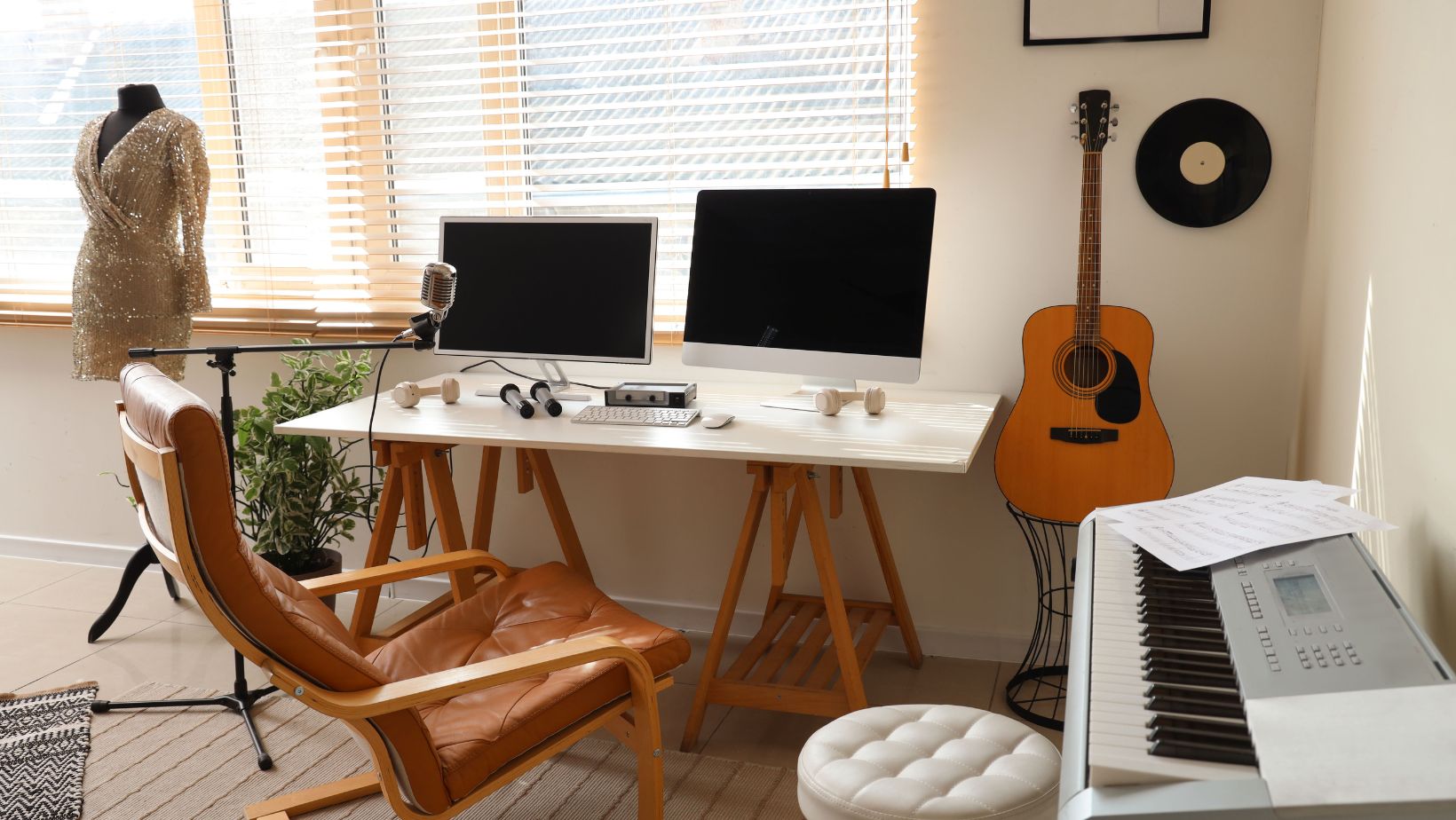
There are many external audio interfaces on the market, all serving the common purpose of faithfully transmitting signals to your DAW and to the monitors. The device should combine microphone and instrument inputs. For our setup, we chose the Audient iD14 MKII — a new model that fits perfectly. The MKII features high-quality Audient Console microphone preamplifiers, previously found only on the brand’s flagship consoles.
It’s worth noting that built-in microphone preamps are often the Achilles’ heel of such devices: they are noisy, add distortion, and color the sound. The iD14 MKII uses components with ultra-low self-noise and minimal non-linear distortion.
Based on our listening experience, the presentation has a certain nod towards analog sound with its softness and warmth, even though it’s a hybrid of discrete and operational amplifiers. The manufacturer claims its device has a noise level 30,000 times lower than the useful signal level, and we have no reason to distrust them — we’ll believe our ears.